
Government of Sudurpashchim Province
Sudurpashchim Investment and Development Summit
Dhangadhi, Kailali

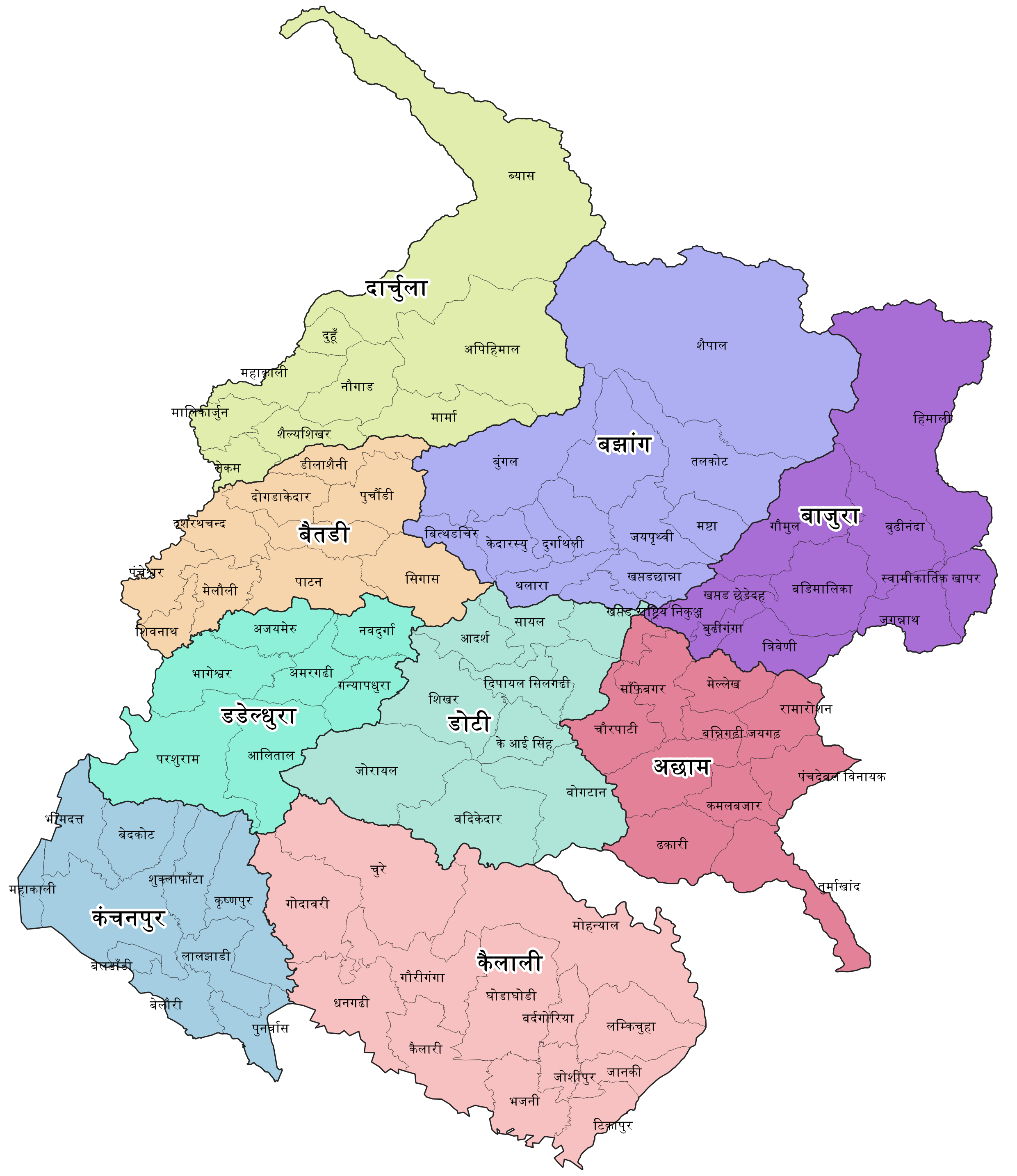
Sudurpashchim province is
the western part of the country and, shares boarder with Karnali province (East
and north), Lumbini Provinces (East), India- Uttarakhand and Uttar Pradesh
(West and South) and China, Tibet (North and north-west). The province covers
an area of 19,999.28 sq. k. m. (13.55 % of total area of Nepal). It has 16
federal parliamentary and 32 provincial parliamentary constituencies, 1
sub-metropolitan city, 33 municipalities and 54 rural municipalities.
The National Census recorded
the total population of the province as 26,94,783 (Female-14,21,997 - 52.77%
and male-12,72,786 – 47.23%). Out of total population,
62.4 percent population live in urban areas (municipalities) and 37.6 percent
population live in rural areas. The annual population growth rate is 0.52
percent with sex ratio of 52.77 and population density at 138. It has 59.5 per
cent of population 15-49 years of age and 12.75 per cent (3,43,523) population
are recorded as absentee population. The life expectancy of Sudurpashchim province
is 66.93 years of age (National – 68.38). The literacy rate is 76.2 per cent
(Female: 68.2 per cent and 85.4 per cent) with 31 percent of population have
only attained basic education level.
The Human Development Index
(HDI) for the province is 0.547
(0.587 is national HDI) and multidimensional poverty index (MPI) is 25.3% (17.4 % is national
level). The Gross Domestic Product (GDP) contribution from the Sudurpashchim
Province shared 6.8 per cent to the national GDP of 2020/21 (Rs. 48.51 billion)
and, the highest contribution was from Bagmati province as 36.9 percent. The
per capita income of the province is 1031.00 USD (National – 1372.00 USD) with
the highest at Bagmati province as 2430.00 USD (MoF, 2023).
Accounting
for around eight percent of Nepal’s GDP, major sectors of the province include
agriculture, forestry, and fishing, that account for over a third of its
provincial GDP. With a rudimentary private sector, public administration and
defense is the second largest contributor to provincial GDP (14 percent).
Nevertheless, education accounts for 14 percent of the provincial GDP, followed
by wholesale and retail (nine percent), and construction (eight percent).
Growth driving sectors such as manufacturing and services have a small presence
in the province with manufacturing contributing to four percent of provincial
GDP, with services such as transportation, financial services, ICT among others
accounting for less than 10 percent.
Figure (4): GDP Composition: Sudurpashchim Province FY 2019/20

Source: CBS (2020/21)
Surdurpashchim
province hosts a total of 62 foreign-invested enterprises. Nevertheless,
spatial disparities are common across districts. In Surduspashchim Province,
out of 122 industries – that are completely domestic and with FDI – 40 percent
of all industries are in Kailali, while 26 percent are situated in Kanchanpur.
In contrast, Bajhang and Doti have only one industry, Dadeldhura and Darchula
have three and Bajura has no industry registered. In terms of foreign
investment in Sudurpashchim province, 51 percent of all industries in the
province have some form of FDI. Within the province, all four industries in
Accham and eight in Baitadi have FDI, while 71 percent of industries in
Kanchanpur and three out of five industries in Dadehldhura have foreign
investment. The number of total registered industries and those with foreign
investment is listed in Table 1 below.
Table
(1): Total industries and industries with FDI up to FY 2020/21
|
District |
Total Industries |
Industries with FDI |
Industries with FDI (%) |
|
Achham |
4 |
4 |
100.0% |
|
Bajura |
3 |
0.0% |
|
|
Baitadi |
8 |
8 |
100.0% |
|
Bajhang |
6 |
1 |
16.7% |
|
Dadeldhura |
5 |
3 |
60.0% |
|
Darchula |
9 |
3 |
33.3% |
|
Doti |
6 |
1 |
16.7% |
|
Kailali |
49 |
19 |
38.9% |
|
Kanchanpur |
32 |
23 |
71.9% |
|
Sudurpaschim Province |
122 |
62 |
50.8% |
Source: Industrial Statistics 2020/21, Department of Industries